


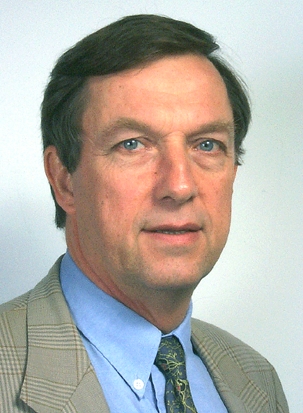
Professor David John Hugh Cockayne FRS, Emeritus Professor in the Physical Examination of Materials at the University of Oxford, died on 22nd December 2010. He was one of the leading Electron Microscopists of Materials of his generation. He was born in London in 1942, and his family emigrated to Melbourne when he was eight years old. He had joint British and Australian (naturalized) nationality, and his professional career was divided between the two countries. He was a Fellow of both the UK and Australian Institutes of Physics. After graduating with first class Honours in Physics at the University of Melbourne in 1964, he carried out research towards the MSc with Professors J.M. Cowley, A.F. Moodie and P. Goodman on electron diffraction from crystals. His project was the first test of the Multislice Theory of electron diffraction of Cowley and Moodie by comparing observed intensity distributions in convergent beam patterns from MoS2 with theoretical prediction. The comparison gave good agreement (after correction of an incorrect sign in the original Cowley-Moodie equations).
In 1966 David moved to Oxford on a Commonwealth Scholarship to the Department of Metallurgy, to carry out research towards the D.Phil supervised by M.J. Whelan FRS. The object of the project was to probe the strainfield of dislocations close to their cores. The result was the development (with I.L.F. Ray and M.J. Whelan) of the dark field “weak beam” technique which improved by an order of magnitude (to 1.5nm) the resolution at which complex lattice defects could be studied. The technique greatly advanced our understanding of the structure and properties of lattice defects through its application to many materials, and become a routine tool in laboratories all over the world. It is still widely used today.
In 1974 Cockayne returned to Sydney University as Director of the Electron Microscope Unit, which he expanded greatly both for services and research. The research was absorbed into the Australian Key Centre for Microscopy and Analysis which he founded and directed at Sydney University. With McKenzie he developed a powerful electron diffraction technique within an electron microscope to study the structure of amorphous materials in volumes orders of magnitude smaller than is possible with x-rays or neutrons, and giving interatomic distances accurate to 0.001nm. Applications included the first proof of the existence of local diamond like structures in thin films of amorphous carbon, and the refinement of the structure of C70.
In 2000 David returned to Oxford as Professor in the Physical Examination of Materials. Here he built up an outstanding Electron Microscopy Group. Highlights of his group’s work included the discovery by careful electron microscopy and atomistic modelling an important new mechanism of strain relief by elemental surface segregation in semiconductor alloy quantum dots, and the location of dopant atoms at the interface of the thin amorphous films between crystalline grains in polycrystalline Si3N4.
Cockayne’s work was characterised by a profound insight into the complexities of electron diffraction and microscopy, and a deep understanding of quite difficult experimental observations. He was elected to the Royal Society in 1999, and was honoured in 2008 with the Massey Medal jointly awarded by the UK and Australian Institutes of Physics.
Cockayne also made outstanding contributions to the promotion, dissemination and teaching of electron microscopy, particularly to the young. During his Sydney period he initiated a highly successful “Microscopes on the Move” programme in which a specially adapted scanning electron microscope could be transported to schools for hands-on operation across the country. With Kirkland he developed in the UK a remote control Cyber SEM Programme with schools which is currently in operation.
He provided exemplary leadership nationally and internationally for the Electron Microscope community. He was Foundation President of the Australian Society for Electron Microscopy. He became General Secretary in 1995 and then President of the International Federation of Societies for Electron Microscopy from 2003 to 2007. He has had a wide ranging and lasting impact in Electron Microscopy of Materials.
He leaves a widow, Jean, and three children, Sophie, Tamsin and James.
Professor Sir Peter Hirsch, FRS
Dr P.D. Nellist
Professor A. I. Kirkland
Department of Materials
University of Oxford
16 Parks Road
Oxford
OX1 3PH