


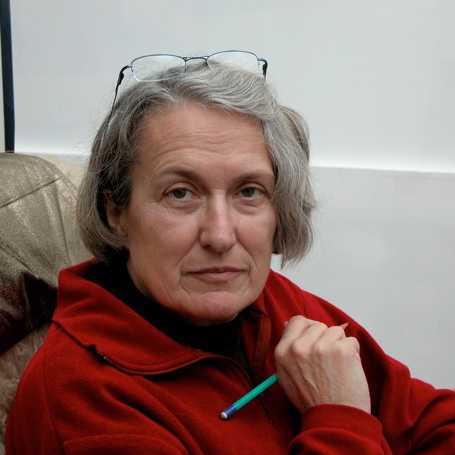
On Thursday the 27th of October 2011, we were deeply saddened to learn of the passing away of Jany Thibault. She was a renowned and deeply respected figure, recognized nationally and internationally in electron microscopy and in particular in the field of high-resolution imaging and plasticity.
Jany Thibault (- Desseaux then – Pénisson) was born in 1947. She spent her youth in Paris and then joined Grenoble, where she graduated as an ingénieur at the Institut National Polytechnique of Grenoble. She began her scientific career at the CEA-Grenoble in 1974, conducting her thesis in the Department of Solid State Physics under the direction of Alain Bourret. She was then associated with the early development of high-resolution electron microscopy and in 1975 published her first results at high accelerating voltages. She then turned to the observation at lower voltages of atomic columns in semiconductor materials and in particular germanium. It is for this material that she recorded the first images of the cores of dislocations at the atomic scale. She revealed the dissociation of dislocations in these materials and defended her PhD in 1977 by presenting these world firsts. She received the Prix Alain Brelot of the French Physical Society in 1979 for her thesis.
She was recruited by the CNRS in 1978 and continued to work at the CEA-Grenoble in the Department of Fundamental Research. She then published the first comparison of the experimentally observed atomic scale displacements around an edge dislocation with elasticity theory calculations. In 1980, she showed for the first time that the method of separation of 60° dislocations in germanium and silicon was by glide. As a natural continuation, she then focused on the atomic structure of grain boundaries in these semiconductors, and later in metals, and showed that these structures are often perfectly ordered. She was able to describe the different models consistent with the experimental high-resolution images. In 1983, she won the bronze medal of the CNRS.
In 1987, with two of her PhD students, Mohamed El Kajbaji and Jean-Luc Putaux, she began the study of interaction of dislocations with grain boundaries, a subject that would interest her for the rest of her life. She assumed the direction of electron microscopy at the CEA-DRFMC and was appointed Director of Research at the CNRS.
Fascinated by the microscope that can “see” atoms, always curious to understand how atoms arrange themselves next to one another, how they come together and organize themselves in defects, she then widens her scope to other materials, such as metals and problems of relaxation in metallic multilayers systems (thesis of P. Bayle-Guillemaud) and oxides. She also participated to the understanding of early growth patterns of single-wall carbon nanotubes (CNT) by analyzing the interface between the catalyst and the CNT. In 1996, she introduced to her laboratory the emerging technique of energy filtering to perform chemical analysis at the sub-nanometre scale. She worked on many projects in nanomaterials, where her knowledge of the structure of defects and interfaces was much appreciated.
In 2004, she decided to join the University Paul Cézanne in Marseille to mount a major project for aberration-corrected high-resolution microscopy as part of the CIM-PACA and create the local network of quantitative microscopy MET-PACA.
Throughout her career, Jany Thibault was an ambassador of high-resolution microscopy in both the national community and abroad. She was a regular invited speaker in major conferences of electron microscopy and participated during all these years to the training of young microscopists in many national and international schools in microscopy and materials. She also became involved in the drafting of monographs on grain boundaries in semiconductors, and later in other materials.
Jany Thibault was a brilliant physicist and microscopist and is already deeply missed by our whole community. She was also a woman of character that anyone who had the privilege of meeting cannot forget. Her knowledge, both scientific and cultural, impressed and was always combined with a real humanity and joie de vivre. She was also an artist, finding in painting and drawing a very personal way to express the world.
We express our sincerest sympathy to her husband Jean-Michel Pénisson, co-worker and companion for life. Let him know that the reactions to the announcement of her departure have all reflected a deep sadness. Illness removed her too soon; we keep a fond memory of an exceptional woman.
Alain Bourret
Pascale Bayle-Guillemaud