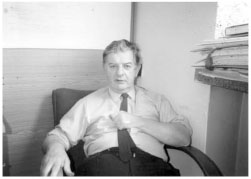
The world of electron optics and electron microscopy has lost a respected and well-loved pioneer. Tom Mulvey became involved in electron microscopy in the first post-war years though as a schoolboy he happened to encounter the name of another great pioneer, Manfred von Ardenne. Tom was an early “wireless fan” and came across the English translation of one of von Ardenne’s books, Television Reception, in about 1936.
In 1949, he took his MSc at Manchester University with a thesis on “The symmetric lens as an element of the electrostatic microscope”, after which he joined the research establishment of the Metropolitan-Vickers Company at Aldermaston Court. Here he encountered Dennis Gabor and designed a column specifically for electron holography. He obtained the very first hologram (zinc oxide crystals) but the experiments were discontinued in the absence of coherent sources. In the following years, he contributed to a host of projects: high-voltage stability, magnetic circuit design, alignment, deflector design, spherical-aberration correction, distortion-free imaging conditions and ion sources. Here too he met his future wife Rita, whom he married in 1955; at the end of her life, she needed constant care and Tom unhesitatingly abandoned many of his regular activities to look after her.
In 1965, Tom Mulvey moved to Birmingham, where he was appointed Reader in Electron Physics at what was then the Birmingham College of Advanced Technology (now Aston University). His years there will be remembered for his work on a battery of unconventional magnetic lenses, on which a series of research students, often from Egypt, the Middle East and even further away prepared their dissertations. Those students remember with great affection and respect the professor who helped them to settle in England, who invited them to his home and involved himself closely in all their doings. Tom, an enthusiastc linguist, added a knowledge of Arabic to his German, Chinese and Russian!
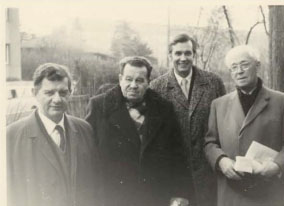
It was during these years that Tom Mulvey began making regular visits to electron opticians and microscopists behind the Iron Curtain, to Halle in East Germany and Brno in Czechoslovakia in particular. Not only did he bring papers and books but above all, he made those isolated scientists feel part of the scientific community.
Another major interest was the history of electron microscopy. His first contribution was ‘Origins and historical development of the electron microscope’, a remarkable piece of work for very little had been written about these matters at that date, apart from two review articles by Ruska and Gabor. Many such historical articles followed as well as biographical studies of several major figures: Jan le Poole, V. Ellis Cosslett and Ernst Ruska.
Many more details of his life together with appreciative memoirs from many of his friends are to found in the “Celebration” of his 80th birthday in Proc. Roy. Microc. Soc. 39 (2004) 206-233 and a near-complete list of his publications appears in J. Microsc. 179 (1995) 97-104.
Tributes have flooded in since the news of his death became known, which demonstrate better than any words of mine the affectionate respect and esteem in which he was held world-wide. The European Microscopy Society extends its sincere sympathy to his family.